
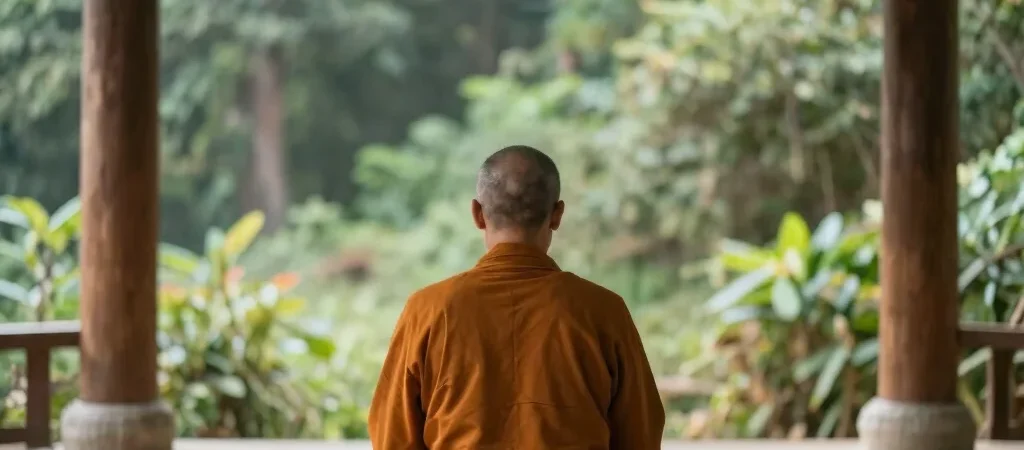
It is time for some light and peaceful Dhamma reading before bedtime.
Today’s Dhamma teaching concerns anger, something that all of us should be mindful of and guard against.
O practitioners of ascetic discipline,
Anger (kodha) is a state of mental irritation, resentment, or displeasure that arises when we encounter an undesirable object or experience.
When anger is held onto and not allowed to subside, it is also called upanāha, meaning the holding of a grudge or persistent resentment.
When one wishes that the person toward whom one feels anger should suffer ruin, destruction, illness, or other misfortunes, this is called byāpāda (ill will).
How, then, can anger be overcome?
According to the words of the Buddha:
“Akkodhena jine kodhaṃ.”
“Conquer anger through non-anger.”
People become angry with one another for many different reasons.
Sometimes, they simply do not get along. As the Thai expressions say, “Their eyes do not agree,” or “Their elements are incompatible.”
Merely seeing the other person brings displeasure. They do not wish to see that person again, speak with them, or offer them any assistance or kindness.
When displeasure arises, it becomes visible through facial expressions and the eyes.
Our eyes are not used only for seeing; they also express our feelings, such as hatred, dislike, affection, suspicion, disgust, and anger.
Thus, it is said:
“Take the eyes as a mirror through which to examine the heart; just as the depth of water may be understood by observing the lotus stems.”
When the other person notices these expressions, they understand what is happening and become displeased in return.
Both sides, each considering themselves strong or unwilling to yield, stop speaking to one another.
If someone asks, “What are you angry about?”
They cannot explain what the matter is.
Yet they remain angry with each other.
If one side simply refrained from becoming angry, the anger of the other side would probably not last very long.
As the Thai proverb says:
“One hand alone cannot make a clapping sound.”
Some people become angry simply because those close to them are angry.
For example, when a wife is angry with someone, her husband becomes angry with that person as well. Or when a husband is angry with someone, his wife also becomes angry.
In this way, they consider themselves to be truly loving toward one another.
If asked, “What has that person done to make you angry?”
The answer is, “I do not know. I saw that my spouse was angry, so I became angry too.”
Some people become angry because their interests conflict.
This is an important cause of anger and can lead to long-lasting hatred.
When their interests become compatible again, their anger disappears.
In reality, when we become angry with someone or hate them, we ourselves are the ones who suffer first, or perhaps suffer even more than the person toward whom our anger is directed.
This is especially true if the other person remains indifferent and does not respond with anger.
In that case, we suffer alone.
The other person remains physically and mentally at ease, while we allow anger to destroy our own happiness.
Anger arises within oneself and then destroys the very person in whom it has arisen.
Therefore, the teaching advises us not to destroy ourselves by allowing anger to gain power over us.
Anger is one of the most dangerous enemies of human beings and all living creatures.
Very few people are able to overcome it completely. Most are defeated by it.
Anger is a merciless victor toward those who lose to it, bringing upon them countless dangers and misfortunes beyond description.
But whoever succeeds in conquering anger receives from that victory the most excellent reward:
The peace and tranquility of the mind, one of the most precious things in human life.
Therefore, let us become students who seek to understand anger, recognize its dangers, and discover the way out of it.
Let us also become warriors who strive to conquer anger and resentment.
Then we shall see how valuable such a victory is to our lives.
There is a saying of the Buddha concerning anger:
“Whoever restrains anger that has arisen, just as a charioteer stops a chariot that is speeding along, that person I call a true charioteer. One who cannot restrain the chariot is not worthy of being called a charioteer; such a person is merely someone holding the reins.”
This refers to the kind of chariot or vehicle that was in use.
Once anger has been restrained, we should make a determined effort to cultivate and radiate loving-kindness (mettā), in accordance with the words of the Buddha:
“Having searched in all directions, one finds no one anywhere who is dearer to oneself than oneself.
In the same way, each person holds themselves most dear.
Therefore, one who loves oneself should not harm others.”
People should not oppress one another.
They should not look down upon or despise one another anywhere.
They should not wish suffering upon one another because of anger or resentment.
Instead, they should develop a mind of boundless loving-kindness toward all living beings.
Just as a mother protects her only child, born of her own body, even at the risk of her life, so should one cultivate loving-kindness.
This is difficult to accomplish.
Nevertheless, it must be done.
Things that are difficult require effort and determination.
“Dukkaraṃ karoti.”
“One does what is difficult to do.”
“Dullabhaṃ labhati.”
“One obtains what is difficult to obtain.”